destroyers. Ships that do not use the AN/SPY-1 are
b e i n g u p g r a d e d t o a s y s t e m k n o w n a s S h i p
Self-Defense System (SSDS). We will discuss SSDS
in another section.
For more than four decades, the U.S. Navy has
developed systems to protect itself from surface and air
attacks. After the end of World War II, several
generations of anti-ship missiles emerged as threats to
the fleet. The first anti-ship missile to sink a combatant
was a Soviet-built missile that sank an Israeli destroyer
in October 1967. This threat was reconfirmed in April
1988 when two Iranian surface combatants fired on
U.S. Navy ships and aircraft in the Persian Gulf. The
resulting exchange of anti-ship missiles led to the
destruction of an Iranian frigate and a corvette by
U.S.-built Harpoon missiles.
The U.S. Navy’s defense against this threat relied
on a strategy of gun and missile coordinated defense.
Guns were supplemented in the late fifties by the first
generation of guided missiles in ships and aircraft. By
the late sixties, although these missiles continued to
perform well, there was still a need to improve missile
technology in order to match the ever-changing threat.
To counter the newer enemy missile threat, the
Advanced Surface Missile System (ASMS) was
developed. ASMS was re-named AEGIS (after the
mythological shield of Zeus) in December 1969.
The AEGIS system was designed as a total weapon
system, from “detection” to “kill”. The heart of the
AEGIS system is an advanced, automatic detect and
track, multi-functional phased-array radar, the
AN/SPY-1. This high-powered (four-megawatt) radar
can perform search, track, and missile guidance
functions simultaneously, with a capability of over 100
targets. The first system was installed on the test ship,
USS Norton Sound (AVM-1) in 1973. Figure 2-6
shows the weapons and sensors on an AEGIS class
cruiser.
The system’s core is a computer-based command
and decision element. This interface enables the
AEGIS combat system to operate simultaneously in
a n t i - a i r w a r f a r e , a n t i - s u r f a c e w a r f a r e , a n d
anti-submarine warfare.
The AN/SPY-1 series radar system works with
two fire control systems on AEGIS class ships: the Mk
99 Missile Fire Control System and the Mk 86 Gun
Fire Control System (part of the Mk 34 Gun Weapon
System). The Mk 86 GFCS is also found on
SPRUANCE class destroyers and works with the Mk
91 Missile Fire Control System. We will discuss the
Mk 91 MFCS in a later section.
Mk 99 Missile Fire Control System
The Mk 99 MFCS controls the loading and arming
of the selected weapon, launches the weapon, and
provides terminal guidance for AAW (Anti-Air
Warfare) missiles. It also controls the target
illumination for the terminal guidance of SM-2
2-5
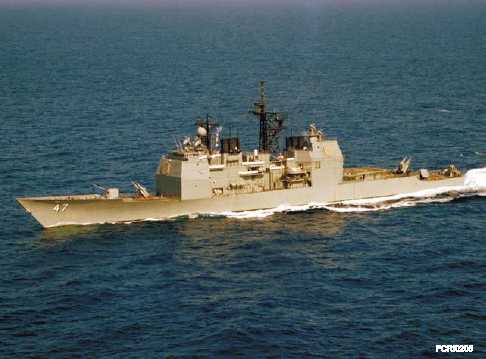
Figure 2-5.—USS Ticonderoga CG-47.