CHAPTER 5
STEAM TURBINES
In previous chapters we discussed the basic
steam cycle and various types of naval boilers. At
this point, we will bring together all you have
learned by discussing the components inside the
turbine casing.
In the following paragraphs we will discuss
turbine theory, types and classifications of
turbines, and turbine construction.
Upon completion of this chapter you will
understand how stored energy (heat) in steam is
transformed to mechanical energy (work).
TURBINE THEORY
The first documented use of steam power
is credited to a Greek mathematician, Hero
of Alexandria, almost 2000 years ago. Hero
built the first steam-powered engine. His
turbine design was the forerunner of the
jet engine and demonstrated that steam power
could be used to operate other machinery.
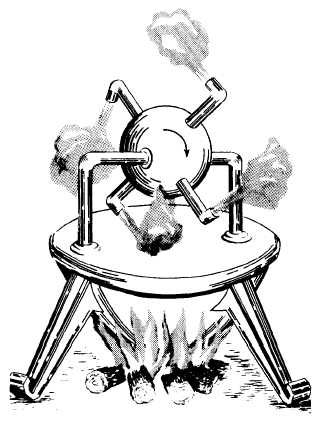
Hero’s turbine (aeolipile) (fig. 5-1) consists
of a hollow sphere and four canted nozzles.
The sphere rotates freely on two feed tubes
that carry steam from the boiler. Steam
generated in the boiler passes through the
feed tubes, into the sphere, and out through
the nozzles. As the steam leaves the nozzles,
the sphere rotates rapidly.
Down through the ages, the application of
the turbine principle has been used in many
different types of machines. The water wheel
that was used to operate the flour mills in
colonial times and the common windmill used
to pump water are examples of the turbine
principle. In these examples, the power comes
from the effect of the wind or a stream of
water acting on a set of blades. In a steam
Figure 5-1.—Hero’s turbine (aeolipile).
turbine, steam serves the same purpose
wind or the flowing water.
as the
Two methods are used in turbine design and
construction to get the desired results from a
turbine. These are the impulse principle and the
reaction principle. Both methods convert the
thermal energy stored in the steam into useful
work, but they differ somewhat in the way they
do it. In the following paragraphs we will discuss
the two basic turbine principles, the impulse and
reaction.
5-1