opening and the balloon will shoot off in the
opposite direction.
When the balloon is filled with air, you have
potential energy stored in the increased air
pressure inside. When you let the air escape, it
passes through the small opening. This represents
a transformation from potential energy to kinetic
energy. The force applied to the air to speed up
the balloon is acted upon by a reaction in the
opposite direction. This reactive force propels the
balloon forward through the air.
You may think that the force that makes the
balloon move forward comes from the jet of air
blowing against the air in the room, not so. It is
the reaction of the force of the air as it passes
through the opening that causes the balloon to
move forward.
The reaction turbine has all the advantages of
the impulse-type turbine, plus a slower operating
speed and greater efficiency. The alternating rows
of fixed and moving blades transfers the heat
energy of the steam to kinetic energy, then to
mechanical energy.
We have discussed the simple impulse and
reaction turbines. Practical applications require
various power outputs. Turbines are constructed
with one or more simple turbines made as one.
This is done in much the same way that the
varying cylinder size of a car engine varies
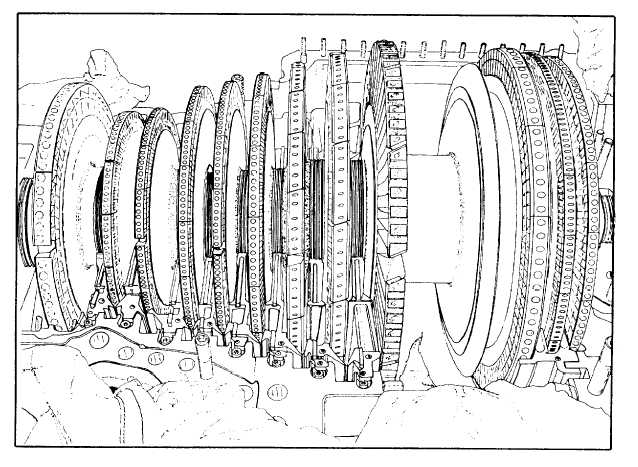
power. Figures 5-6 and 5-7 show typical naval
turbines.
TURBINE CLASSIFICATION
So far we have classified turbines into two
general groups: IMPULSE TURBINES and
REACTION TURBINES, depending on the
method used to cause the steam to do useful
139.58
Figure 5-6.—Impulse main propulsion turbine.
5-4