CHAPTER 6
GAS TURBINES
This chapter will provide you with a basic
understanding of the history and development of
gas turbine engines. This chapter will also discuss
basic gas turbine engine theory, types, construc-
tion features, and operating principles.
HISTORY AND BACKGROUND
Until recent years, it has not been possible to
separate gas turbine and jet engine technology.
The same people worked in both fields, and the
same sciences were applied to both types of
engines. Recently, the jet engine has been used
more exclusively as a part of aviation. The gas
turbine has been used for the generation of
electricity, ship propulsion, and experimental
automobile propulsion. Many operational turbine
power plants use aircraft jet engines as a gas
generator (GG), adding a power turbine (PT) and
transmission to complete the plant.
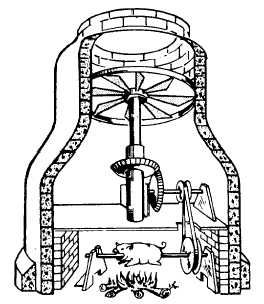
Figure 6-1.—DaVinci’s chimney jack.
In the last chapter we discussed Hero, a
scientist from Alexandria, Egypt. Many sources
credit him as the inventor of the aeolipile (see
chapter 5, fig. 5-1). The aeolipile is considered by
many sources to be the first turbine engine.
Throughout the course of history, there are
examples of other devices that used the principle
of expanding gases to perform work. Among
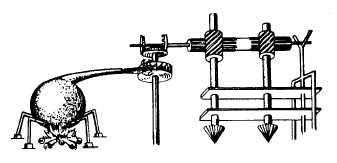
these were inventions of Leonardo DaVinci
(fig. 6-1) and Giovanni Branca (fig. 6-2).
In the 1680s, Sir Isaac Newton described the
laws of motion. All devices that use the theory
of jet propulsion are based on these laws.
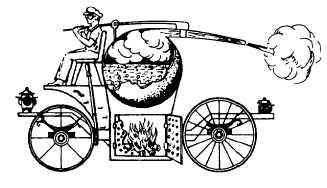
Newton’s steam wagon is an example of his
reaction principle (fig. 6-3).
Figure 6-2.—Branca’s jet turbine.
Figure 6-3.—Newton’s steam wagon.
6-1